Monday, February 19, 2007
Over a thousand copies sold now
The first print was 1000 and the second was 500. It seems to have sold quite well. All sorts of people email me with congratulations. They say I have set them thinking. The latest was a former currency trader. Helen Dew and I sold nine copies between us at the recent Levin Organic River Festival and spoke with all sorts of people during the weekend. We also ran two workshops one with Helen and me and the other with Gary Williams, Singa Sheen and me regarding a proposed local voucher scheme.

Wednesday, August 02, 2006
Ian Grant reviews book for Management Magazine
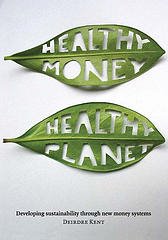
Healthy Money, Healthy
Planet
By: Deirdre Kent
Publisher: Craig Potton Publishing
Price: $34.99
Sustainability is a current buzz word among politicians and business leaders. It is on many lips; but lip service is about as far as it usually goes.
There’s barely even lip service paid to the idea that our present economic system is not sustainable. It’s a bit like democracy. Most of us accept it without question; some worry about it but decide the alternatives are worse. Yet there are growing doubts about the sustainability, the very survival of the economic system that makes most of the world go round, and that we all depend on so completely.
Deirdre Kent’s Healthy Money, Healthy Planet both confronts the realities and considers some of the alternatives. She argues, as do economists like Richard Douthwaite, that the present debt-based global economic system must continue to grow or it will collapse. “The ritual worship of the desirability of economic growth” can, she writes, be traced to capitalism’s total dependence on continuous economic growth because of the need to pay interest on borrowed money. Almost all our money supply is created by interest-bearing debt by private banks; the Reserve Bank has confirmed that only 2 percent of the money in use in New Zealand is created interest-free.
Collapse is not just a theoretical possibility: witness the Argentinian and Thai economies and Japan’s struggle with its banks’ bad debts for over a decade. “At the time of writing,” noted Kent, “Japan spends more than 40 percent of its taxation revenue servicing debt…” As Clyde Prestowitz pointed out in Three Billion New Capitalists (reviewed in Management Ausust 2005) there is increasing concern about America’s ability to fulfil its international financial obligations: the US trade (current account) deficit was about $650 billion in 2004, financed by huge overseas borrowing, and mortgaging large US assets to foreign lenders.
Deirdre Kent, previously the tenacious leader of the country’s anti-smoking lobby, has written an impeccably researched book that deserves to be read. It discusses, in an agreeably jargon-free and readable fashion, how the current system works, or doesn’t. It looks at complementary economies and monetary systems – at possible changes to taxation, community banking, commercial barter – that have been tried successfully in various parts of the world.
The increasingly stark reality is that unfettered, unthinking growth is now both unsustainable and increasingly unacceptable. Healthy Money, Healthy Planet should be a valuable resource in the essential, and overdue, debate on our economic options.
Rating 4
Planet
By: Deirdre Kent
Publisher: Craig Potton Publishing
Price: $34.99
Sustainability is a current buzz word among politicians and business leaders. It is on many lips; but lip service is about as far as it usually goes.
There’s barely even lip service paid to the idea that our present economic system is not sustainable. It’s a bit like democracy. Most of us accept it without question; some worry about it but decide the alternatives are worse. Yet there are growing doubts about the sustainability, the very survival of the economic system that makes most of the world go round, and that we all depend on so completely.
Deirdre Kent’s Healthy Money, Healthy Planet both confronts the realities and considers some of the alternatives. She argues, as do economists like Richard Douthwaite, that the present debt-based global economic system must continue to grow or it will collapse. “The ritual worship of the desirability of economic growth” can, she writes, be traced to capitalism’s total dependence on continuous economic growth because of the need to pay interest on borrowed money. Almost all our money supply is created by interest-bearing debt by private banks; the Reserve Bank has confirmed that only 2 percent of the money in use in New Zealand is created interest-free.
Collapse is not just a theoretical possibility: witness the Argentinian and Thai economies and Japan’s struggle with its banks’ bad debts for over a decade. “At the time of writing,” noted Kent, “Japan spends more than 40 percent of its taxation revenue servicing debt…” As Clyde Prestowitz pointed out in Three Billion New Capitalists (reviewed in Management Ausust 2005) there is increasing concern about America’s ability to fulfil its international financial obligations: the US trade (current account) deficit was about $650 billion in 2004, financed by huge overseas borrowing, and mortgaging large US assets to foreign lenders.
Deirdre Kent, previously the tenacious leader of the country’s anti-smoking lobby, has written an impeccably researched book that deserves to be read. It discusses, in an agreeably jargon-free and readable fashion, how the current system works, or doesn’t. It looks at complementary economies and monetary systems – at possible changes to taxation, community banking, commercial barter – that have been tried successfully in various parts of the world.
The increasingly stark reality is that unfettered, unthinking growth is now both unsustainable and increasingly unacceptable. Healthy Money, Healthy Planet should be a valuable resource in the essential, and overdue, debate on our economic options.
Rating 4
Wednesday, July 05, 2006
Paul Glover's review in Yes! Magazine
Review published in Yes! Magazine May 2006
Healthy Money Healthy Planet
by Deirdre Kent
reviewed by Paul Glover
There are already thousands of run-for-your-life crisis books. Celebrations of success are rarer. Deirdre Kent’s book Healthy Money, Healthy Planet is a fine contribution to the latter, a great find for those who want to convert bad news into good news that exemplifies the world we want.
Community currencies, for example, have begun to prove that economics and ecology can become friends. Local cash can fix problems that dollars ignore.
Healthy Money helps currency organizers more effectively explain the differences between money which connects people and money that controls people. Kent starts with an authoritative history of national money systems.
Commercial bankers create money just by signing loan contracts. Only ten percent of the dollars lent are backed by bank reserves; 90% are fantasy credits. Here’s the trick: the interest charged can never be repaid because, like musical chairs, the money lending game doesn’t provide enough credits for repaying both principle and interest. The resulting deliberate dollar scarcity forces a desperate scramble for sales regardless of damage to communities and nature.
Bankers foreclose the inevitable losers then control more wealth than ever. And control of money decides where jobs are available and for how long; decides who owns land and what gets built; decides what is legal and what’s a crime; decides who lives well and who struggles. (For a fuller discussion of money systems, see Thomas Greco, “The Trouble with Money,” and Bernard Lietaer, “Beyond Greed and Scarcity,” YES! Summer 1997.)
Why should bankers have all the fun? Healthy Money provides two essential tools to citizens creating community currency that’s dedicated to social justice, environmental repair, and neighborhoods. First, it introduces the varieties of grassroots credit systems and summarizes their strengths and weaknesses.
Kent compares the multitude of paper scrips, digital credits, smart cards, and barter banks. She prefers that monetary theorists take action, and risk blundering in the real world.
At the same time, Kent exhorts community organizers to act on the larger stage. She endorses “healthy globalization” for labor rights and environmental justice. She is enthusiastic about commodity-backed international currency (like the Borsodi Constant), and carbon emission rights currency. The Constant’s value was measured by aggregate current sales from harvests and mines, while trading the rights to spew carbon oxides seeks to cap global pollution. She recommends that currency activists learn business sense from those who comprehend profit and loss.
And since money when banked multiplies its force, community banking is considered just as necessary as community currency.
Some community currency advocates are skeptical of local currencies that are not backed by national currency. But all national currencies are in debt to nature, since modern economies extract resources faster than they replenish.
Even the United States’ dollar is backed no longer by vast domestic petroleum reserves, boundless woodlands and deep soils, nor by gold or silver, but by $6 trillion debt, rusting industry, and declining military control of foreign oil.
That’s why HOUR systems (ithacahours.com) are deliberately backed by local labor and sustainable partnership with nature. As the notes say, “HOURS are backed by real capital: our skills, our time, our tools, forests, fields and rivers.” When dollars, euros, yen and yuan fade, HOURS can take over.
Kent does not pretend to have written a how-to manual. She seems like a genial schoolteacher walking the rows, inviting our attention to choices. But Healthy Money prepares us well to understand finance, while making it serve our neighborhoods and revive the planet ourgrandchildren will inherit.
Paul Glover is founder of Ithaca HOURS, the Ithaca Health Alliance, and Citizen Planners of LosAngeles. He is a consultant for grassroots economic development: paulglover.org
____
Healthy Money Healthy Planet
by Deirdre Kent
reviewed by Paul Glover
There are already thousands of run-for-your-life crisis books. Celebrations of success are rarer. Deirdre Kent’s book Healthy Money, Healthy Planet is a fine contribution to the latter, a great find for those who want to convert bad news into good news that exemplifies the world we want.
Community currencies, for example, have begun to prove that economics and ecology can become friends. Local cash can fix problems that dollars ignore.
Healthy Money helps currency organizers more effectively explain the differences between money which connects people and money that controls people. Kent starts with an authoritative history of national money systems.
Commercial bankers create money just by signing loan contracts. Only ten percent of the dollars lent are backed by bank reserves; 90% are fantasy credits. Here’s the trick: the interest charged can never be repaid because, like musical chairs, the money lending game doesn’t provide enough credits for repaying both principle and interest. The resulting deliberate dollar scarcity forces a desperate scramble for sales regardless of damage to communities and nature.
Bankers foreclose the inevitable losers then control more wealth than ever. And control of money decides where jobs are available and for how long; decides who owns land and what gets built; decides what is legal and what’s a crime; decides who lives well and who struggles. (For a fuller discussion of money systems, see Thomas Greco, “The Trouble with Money,” and Bernard Lietaer, “Beyond Greed and Scarcity,” YES! Summer 1997.)
Why should bankers have all the fun? Healthy Money provides two essential tools to citizens creating community currency that’s dedicated to social justice, environmental repair, and neighborhoods. First, it introduces the varieties of grassroots credit systems and summarizes their strengths and weaknesses.
Kent compares the multitude of paper scrips, digital credits, smart cards, and barter banks. She prefers that monetary theorists take action, and risk blundering in the real world.
At the same time, Kent exhorts community organizers to act on the larger stage. She endorses “healthy globalization” for labor rights and environmental justice. She is enthusiastic about commodity-backed international currency (like the Borsodi Constant), and carbon emission rights currency. The Constant’s value was measured by aggregate current sales from harvests and mines, while trading the rights to spew carbon oxides seeks to cap global pollution. She recommends that currency activists learn business sense from those who comprehend profit and loss.
And since money when banked multiplies its force, community banking is considered just as necessary as community currency.
Some community currency advocates are skeptical of local currencies that are not backed by national currency. But all national currencies are in debt to nature, since modern economies extract resources faster than they replenish.
Even the United States’ dollar is backed no longer by vast domestic petroleum reserves, boundless woodlands and deep soils, nor by gold or silver, but by $6 trillion debt, rusting industry, and declining military control of foreign oil.
That’s why HOUR systems (ithacahours.com) are deliberately backed by local labor and sustainable partnership with nature. As the notes say, “HOURS are backed by real capital: our skills, our time, our tools, forests, fields and rivers.” When dollars, euros, yen and yuan fade, HOURS can take over.
Kent does not pretend to have written a how-to manual. She seems like a genial schoolteacher walking the rows, inviting our attention to choices. But Healthy Money prepares us well to understand finance, while making it serve our neighborhoods and revive the planet ourgrandchildren will inherit.
Paul Glover is founder of Ithaca HOURS, the Ithaca Health Alliance, and Citizen Planners of LosAngeles. He is a consultant for grassroots economic development: paulglover.org
____
Tuesday, June 27, 2006
I have been invited to Australia
On 13 July I am off to Australia with my partner Malcolm Murchie. I was invited by ERA (Economic Reform Australia) and will speak in five places – Brisbane, Maleny, Crystal Waters, Sydney and Adelaide.
The Brisbane event is at the conference of Students of Sustainability. I will be appearing with two others Professor Bob Blain of USA and Dr Geoff Davies of Canberra, author of Economiia. In Canberra we are at the Forum on Nature and Society, which sounds an interesting group.
Right now I am flat out preparing powerpoints which are up to date on local currencies. I have discovered that last week in New Zealand Greendollars Nelson New Zealand was launched by the owners of a commercial barter company OZONE. OZONE has 3000 trade members in New Zealand so the members of this new green dollars will be able to trade with 3000 businesses. I am keen to learn more.
We have to take three boxes of books with us for sale.
The Brisbane event is at the conference of Students of Sustainability. I will be appearing with two others Professor Bob Blain of USA and Dr Geoff Davies of Canberra, author of Economiia. In Canberra we are at the Forum on Nature and Society, which sounds an interesting group.
Right now I am flat out preparing powerpoints which are up to date on local currencies. I have discovered that last week in New Zealand Greendollars Nelson New Zealand was launched by the owners of a commercial barter company OZONE. OZONE has 3000 trade members in New Zealand so the members of this new green dollars will be able to trade with 3000 businesses. I am keen to learn more.
We have to take three boxes of books with us for sale.
Tuesday, May 30, 2006
A review in New Zealand Books from an economist
The following review appeared in the June 2006 edition of a publication called New Zealand Books. I am a little reluctant to put it on the website as it has a few inaccuracies. An author feels a little weird when someone gets a fact or two wrong..Anyway it seems he has cottoned on to what the book is about, particularly the chapter on diversity and on organic organisation and thinks it worthwhile reading. Some of his sentences are hard to understand and I am not sure that he reiterates or rephrases what I actually said. Deirdre
Current Account
Robin Johnson
Healthy Money Healthy Planet: Developing Sustainabiilty through new Money Systems
Deirdre Kent
Craig Potton Publishing $34.99
ISBN 1877333298
This book is a serious critique of orthodox economic writing and attempts to set out an alternative interpretation of the role of money in society. In particular, it attacks the creation of credit by the banking system and lack of controls over the money supply. The viewpoint is international as well as domestic and hence includes world monetary influences as well as those of particular countries. In summary the author deplores the concentration of wealth and power in a small percentage of the population, the undue influence of multinational corporations, the lack of regard for natural resources, and the baleful influence of international specialisation (world trade reform) on local economies.
The author presents a case for the reform of the money system consistent with a view of society that is self-reliant, environmentally friendly and helpful to all levels. She reviews what she calls complementary economic and monetary systems that might mitigates some of the worst features of the international monetary system she identifies. Complementary currencies are those set up to give the power to issue money to people at all levels of organisation. These have been developed in a number of countries, including New Zealand, and their implementation could overcome foreign or bank control of the money supply. If implemented they would require the introduction of community banking and local participation, the encouragement of commercial barter and exchange, enhanced local currency circulation and alternative means of exchange, like voucher schemes, in parallel with national and international systems.
For an economist this is a serious challenge, and, I believe Kent’s proposals are unlikely to be workable. However, for the non-economist, the book is an informative read on everyday aspects of the economy, particularly the workings of the monetary system and the author’s interpretation of it.
The title of the book derives from the author’s metaphor of an organic model for a healthy economy – thinking of it as a living system. It’s her view that in a healthy global economy there would be no essential conflict between what is good for the local region and what is good for the planet; and in a national economy, its parts, while competing for attention by demonstrating their uniqueness, should all cooperate and help each other at optimal capacity.
The author speaks of managed borders. In a human cell, if the cell membrane is removed, the contents will leak out and pathogens will enter the cell. While goods, services,, energy and money are all allowed to circulate freely within the economy, the borders should be managed to allow vital materials, energy and information to pass through. In an organic, hierarchic model each economy – supranational, national, regional, local and neighbourhood – would be a complete unit. To retain integrity each would have its own currency, while also using the national and international currencies for trade within the larger unit.
Kent follows other writers in this area by setting out operational characteristics of a healthy holarchic (a term said to come from Arthur Koestler, meaning that each living part of an organism is whole but also depends on cells around it; a group of such cells is a holarchy system). These characteristics are based on the following ecological principles: life is frugal and sharing; life depends on inclusive, place-based communities; life depends on boundaries; and life thrives on diversity, creative individuality and shared learning.
Theese propositions can be used to recreate economic institutions in the service of “life”. Thus:
"Human economies can and should function as self-organising systems in which each individual, family, community or nation is able to exercise its freedom of choice, mindful of the needs of the whole, and no entity has the power to dominate any other. Human economies can and should be organised to contribute to life’s abundance through frugal use, equitable sharing, and continuous recycling of the available energy and resources to meet the material, social and spiritual needs of all their members. Human economies can and should be built around inclusive, place based communities, adapted to the conditions of their physical space, adept at the collection and conversation of energy and recycling of materials to function as largely self-reliant entities, and organised to provide each of their members with a sustainable means of livelihood."
Human economies can and should acknowledge and reward cooperative behaviour towards the efficient use of energy and resources in providing adequate livelihoods for all and enhancing the productive capacities of a shared pool of living capital. Human economies can and should have managed borders at each level of organisation, from households and community to region and nation, which allow them to maintain the integrity, coherence and resource efficiency of their internal productive processes and to protect themselves from predators and pathogens while cooperating to enhance the potentials of the larger whole. Human economies can and should nurture cultural, social and economic creativity and diversity and share information within and between and between place-based economies. These conditions are the keys to system resilience and creative intelligence.
Now it seems to me that these social institutions are largely built around the Christian ethic and the efficient use of resources, and would be acceptable to economists and non-economists alike. Modern legislation also provides for the control of excessive monopolies and unfair competition, and international agreements are in place for sharing energy resources, preventing unfair trade and the control of bugs and disease (“predators and pathogens”). Where the two approaches seems to part is in the degree of control of local, national and international autonomy sanctioned by society. The author would prefer more local control over events, more self-sufficiency at the household and regional level, and less trade with other entities at all levels.
The political analyst is bound to point out that such an organisational change is well within the powers of democratic voting systems if sufficient people opt for it. The economic analyst would also have to point out that many social reforms of the kind prescribed can only be achieved by some loss of efficiency in the productive system. If there is a loss of efficiency in moving to such a system, there is less wealth to share among the unfortunate and the less advantaged. The very efficiencies gained from specialisation in trade at regional, national and international levels would be largely lost.
In the end it comes down to what kind of society we really want. We need to weigh the advantages and disadvantages of the various options. Most of us would vote for a caring, decently incomed, self-governing form of organisation if the benefits were clear. It could be that the information we have available is insufficient to make a constructive choice – a point suggested in the last of the aboe forms of organisation. Perhaps the most positive aspect of this book is that it exposes much new information and a new view on a subject that concerns everybody; a reading of its contents might influence ways our society might move in the future.
Robin Johnson is an economist and retired civil servant.
Current Account
Robin Johnson
Healthy Money Healthy Planet: Developing Sustainabiilty through new Money Systems
Deirdre Kent
Craig Potton Publishing $34.99
ISBN 1877333298
This book is a serious critique of orthodox economic writing and attempts to set out an alternative interpretation of the role of money in society. In particular, it attacks the creation of credit by the banking system and lack of controls over the money supply. The viewpoint is international as well as domestic and hence includes world monetary influences as well as those of particular countries. In summary the author deplores the concentration of wealth and power in a small percentage of the population, the undue influence of multinational corporations, the lack of regard for natural resources, and the baleful influence of international specialisation (world trade reform) on local economies.
The author presents a case for the reform of the money system consistent with a view of society that is self-reliant, environmentally friendly and helpful to all levels. She reviews what she calls complementary economic and monetary systems that might mitigates some of the worst features of the international monetary system she identifies. Complementary currencies are those set up to give the power to issue money to people at all levels of organisation. These have been developed in a number of countries, including New Zealand, and their implementation could overcome foreign or bank control of the money supply. If implemented they would require the introduction of community banking and local participation, the encouragement of commercial barter and exchange, enhanced local currency circulation and alternative means of exchange, like voucher schemes, in parallel with national and international systems.
For an economist this is a serious challenge, and, I believe Kent’s proposals are unlikely to be workable. However, for the non-economist, the book is an informative read on everyday aspects of the economy, particularly the workings of the monetary system and the author’s interpretation of it.
The title of the book derives from the author’s metaphor of an organic model for a healthy economy – thinking of it as a living system. It’s her view that in a healthy global economy there would be no essential conflict between what is good for the local region and what is good for the planet; and in a national economy, its parts, while competing for attention by demonstrating their uniqueness, should all cooperate and help each other at optimal capacity.
The author speaks of managed borders. In a human cell, if the cell membrane is removed, the contents will leak out and pathogens will enter the cell. While goods, services,, energy and money are all allowed to circulate freely within the economy, the borders should be managed to allow vital materials, energy and information to pass through. In an organic, hierarchic model each economy – supranational, national, regional, local and neighbourhood – would be a complete unit. To retain integrity each would have its own currency, while also using the national and international currencies for trade within the larger unit.
Kent follows other writers in this area by setting out operational characteristics of a healthy holarchic (a term said to come from Arthur Koestler, meaning that each living part of an organism is whole but also depends on cells around it; a group of such cells is a holarchy system). These characteristics are based on the following ecological principles: life is frugal and sharing; life depends on inclusive, place-based communities; life depends on boundaries; and life thrives on diversity, creative individuality and shared learning.
Theese propositions can be used to recreate economic institutions in the service of “life”. Thus:
"Human economies can and should function as self-organising systems in which each individual, family, community or nation is able to exercise its freedom of choice, mindful of the needs of the whole, and no entity has the power to dominate any other. Human economies can and should be organised to contribute to life’s abundance through frugal use, equitable sharing, and continuous recycling of the available energy and resources to meet the material, social and spiritual needs of all their members. Human economies can and should be built around inclusive, place based communities, adapted to the conditions of their physical space, adept at the collection and conversation of energy and recycling of materials to function as largely self-reliant entities, and organised to provide each of their members with a sustainable means of livelihood."
Human economies can and should acknowledge and reward cooperative behaviour towards the efficient use of energy and resources in providing adequate livelihoods for all and enhancing the productive capacities of a shared pool of living capital. Human economies can and should have managed borders at each level of organisation, from households and community to region and nation, which allow them to maintain the integrity, coherence and resource efficiency of their internal productive processes and to protect themselves from predators and pathogens while cooperating to enhance the potentials of the larger whole. Human economies can and should nurture cultural, social and economic creativity and diversity and share information within and between and between place-based economies. These conditions are the keys to system resilience and creative intelligence.
Now it seems to me that these social institutions are largely built around the Christian ethic and the efficient use of resources, and would be acceptable to economists and non-economists alike. Modern legislation also provides for the control of excessive monopolies and unfair competition, and international agreements are in place for sharing energy resources, preventing unfair trade and the control of bugs and disease (“predators and pathogens”). Where the two approaches seems to part is in the degree of control of local, national and international autonomy sanctioned by society. The author would prefer more local control over events, more self-sufficiency at the household and regional level, and less trade with other entities at all levels.
The political analyst is bound to point out that such an organisational change is well within the powers of democratic voting systems if sufficient people opt for it. The economic analyst would also have to point out that many social reforms of the kind prescribed can only be achieved by some loss of efficiency in the productive system. If there is a loss of efficiency in moving to such a system, there is less wealth to share among the unfortunate and the less advantaged. The very efficiencies gained from specialisation in trade at regional, national and international levels would be largely lost.
In the end it comes down to what kind of society we really want. We need to weigh the advantages and disadvantages of the various options. Most of us would vote for a caring, decently incomed, self-governing form of organisation if the benefits were clear. It could be that the information we have available is insufficient to make a constructive choice – a point suggested in the last of the aboe forms of organisation. Perhaps the most positive aspect of this book is that it exposes much new information and a new view on a subject that concerns everybody; a reading of its contents might influence ways our society might move in the future.
Robin Johnson is an economist and retired civil servant.
Thursday, March 23, 2006
Rachel McAlpine reviews book for Kapiti Observer
Review by Rachel McAlpine in Kapiti Observer, 23 March, 2006
Healthy Money Healthy Planet: Developing Sustainability through new money systems, by Deirdre Kent, Craig Potton Publishing.
A new book from Deirdre Kent of Waikanae is in tune with the ideals of Craig Potton Publishing, who produce ‘occasional, but important books on a variety of social and environmental issues.’
What have money systems to do with a healthy planet? The answer is shocking and incredible.
‘The national currency of industrialised nations is created when commercial banks issue loans’, explains Deirdre Kent. ‘Banks created the loan but not the interest to pay it back.”
Thus our economy depends on a shortage of currency, and industrialised nations are all, by definition, eternally, inevitably, permanently, hopelessly in debt. This forces economic growth, which damages our planet. All any government can do is twiddle with the details, if I have got the message right.
To abolish the world monetary system is not realistic, and Deirdre Kent does not suggest such a thing.
But local, complementary currencies can and do coexist, with many benefits.
The book includes a fascinating overview of ‘healthy’ money systems.
Examples in New Zealand include Green dollars, Chatham Island Notes, Flybuys, Air New Zealand Airpoints Dollars, Bartercard and Tradecard. The policies of our big banks are compared with those of Kiwibank, the credit unions and community banks.
This is a lively book about a timely topic that most people barely think about. It is by a non-economist for non-economists – a refreshing approach.
The author repeatedly strikes a note of moderation, for example by quoting JK Galbraith: ‘A constant in the history of money is that every remedy is reliably a source of new abuse.’
(Let me declare my interest: Deirdre Kent is my sister)
Healthy Money Healthy Planet: Developing Sustainability through new money systems, by Deirdre Kent, Craig Potton Publishing.
A new book from Deirdre Kent of Waikanae is in tune with the ideals of Craig Potton Publishing, who produce ‘occasional, but important books on a variety of social and environmental issues.’
What have money systems to do with a healthy planet? The answer is shocking and incredible.
‘The national currency of industrialised nations is created when commercial banks issue loans’, explains Deirdre Kent. ‘Banks created the loan but not the interest to pay it back.”
Thus our economy depends on a shortage of currency, and industrialised nations are all, by definition, eternally, inevitably, permanently, hopelessly in debt. This forces economic growth, which damages our planet. All any government can do is twiddle with the details, if I have got the message right.
To abolish the world monetary system is not realistic, and Deirdre Kent does not suggest such a thing.
But local, complementary currencies can and do coexist, with many benefits.
The book includes a fascinating overview of ‘healthy’ money systems.
Examples in New Zealand include Green dollars, Chatham Island Notes, Flybuys, Air New Zealand Airpoints Dollars, Bartercard and Tradecard. The policies of our big banks are compared with those of Kiwibank, the credit unions and community banks.
This is a lively book about a timely topic that most people barely think about. It is by a non-economist for non-economists – a refreshing approach.
The author repeatedly strikes a note of moderation, for example by quoting JK Galbraith: ‘A constant in the history of money is that every remedy is reliably a source of new abuse.’
(Let me declare my interest: Deirdre Kent is my sister)
Wednesday, February 22, 2006
Organic pathways website reviews book
This is a New Zealand website for those interested in organics. It has published the following review.
Money, Healthy Planet
Developing Sustainability Through New Money Systems
Deirdre Kent
In her preface to Healthy Money Healthy Planet, author New Zealander Deirdre Kent says the book is her contribution to the conversation on how to preserve the planet and resolve economic injustices.
She calls the way money currently operates “sick money” and here’s why:
Income Disparity In New Zealand, since the 1980s, the highest income families have increased their share of income - the top 10 per cent has gained, the next 20 per cent is holding their own.
Meanwhile, the bottom 70 per cent are worse off than 10 years ago.
In 1960, the wealthiest 20 per cent of the world’s population, living in the richest countries, had 30 times the income of the poorest 20 per cent. By 1977, the figure had increased to 74 times.
The assets of the world’s 358 billionaires exceed the combined annual incomes of countries accounting for 2.3 billion people or nearly half the world’s people.
Debt US$40 billion a year flows from developing countries to the developed countries and the developing world now spends US$13 on debt repayment for every US$1 it receives in grants.
As a result of the debt crisis, 7 million children die each year.
Money Creation Healthy Money, Healthy Planet describes how money currently works and shows how increasing financial inequality is built into the system.
She maintains that many of the environmental and social problems result from the creation of money out of thin air by private banks as interest bearing debt. She describes how it works and explains why some central bankers, economists and politicians deny that this is how money works.
Kent is in favour of loans being made, but says the payment of interest on top of the loan creates a situation where there is never enough money in circulation to cover the interest, in practice meaning there must be winners and losers in the current economic system.
In a section on the invisible governments, she lists “secretive” organizations that are dominated by big business interests and that seek to influence governments - powerful and unaccountable groups which make democracy impotent.
Organic Model She explains how healthy money would be the result if the economy was built on an organic model where power is not centralized, and money can also be created at the regional level and used to revitalize regional economies.
She envisages economies nested in economies using a pattern which mimics nature, and which will help keep money circulating at the local and national level, instead of being a one way flow toward oversized points of power as currently happens.
Monetary literacy for the masses Kent is a New Zealand grandmother with a lifelong involvement in political issues, and an interest in challenging underlying assumptions and beliefs, she has always been interested in mathematics (and was a maths teacher).
She advocates monetary literacy for the ordinary person and says economics permeates our lives and is far too important to be left solely to economists. Her book is a good starting point for newcomers as it is written in layperson’s language.
It is also a useful resource for people already interested in monetary reform as it assesses a number of complementary economic and monetary systems which have been tried in various countries, including New Zealand.
Monetary reform resource She assesses the strengths and weaknesses of various currencies, looking at why some have worked and others failed - thus providing a useful reference for people wanting to set up complementary currencies, for instance, which would work alongside the national currency, but would return power to the grassroots level and encourage regional rejuvenation.
Her book includes a table of currencies with their strengths and weaknesses, and a list of useful websites in categories including Green economics, history and theory of money, monetary reform, GDP, organic model of organization, various currencies and ethical investments.
It also lists useful organizations in New Zealand and Australia and has an extensive bibliography. A glossary is a good aid to people taking their first steps in economic literacy.
Craig Potton Publishing
RRP: $34.95
Available from
H. Dew
Living Economies
12 Costley St
Carterton
Money, Healthy Planet
Developing Sustainability Through New Money Systems
Deirdre Kent
In her preface to Healthy Money Healthy Planet, author New Zealander Deirdre Kent says the book is her contribution to the conversation on how to preserve the planet and resolve economic injustices.
She calls the way money currently operates “sick money” and here’s why:
Income Disparity In New Zealand, since the 1980s, the highest income families have increased their share of income - the top 10 per cent has gained, the next 20 per cent is holding their own.
Meanwhile, the bottom 70 per cent are worse off than 10 years ago.
In 1960, the wealthiest 20 per cent of the world’s population, living in the richest countries, had 30 times the income of the poorest 20 per cent. By 1977, the figure had increased to 74 times.
The assets of the world’s 358 billionaires exceed the combined annual incomes of countries accounting for 2.3 billion people or nearly half the world’s people.
Debt US$40 billion a year flows from developing countries to the developed countries and the developing world now spends US$13 on debt repayment for every US$1 it receives in grants.
As a result of the debt crisis, 7 million children die each year.
Money Creation Healthy Money, Healthy Planet describes how money currently works and shows how increasing financial inequality is built into the system.
She maintains that many of the environmental and social problems result from the creation of money out of thin air by private banks as interest bearing debt. She describes how it works and explains why some central bankers, economists and politicians deny that this is how money works.
Kent is in favour of loans being made, but says the payment of interest on top of the loan creates a situation where there is never enough money in circulation to cover the interest, in practice meaning there must be winners and losers in the current economic system.
In a section on the invisible governments, she lists “secretive” organizations that are dominated by big business interests and that seek to influence governments - powerful and unaccountable groups which make democracy impotent.
Organic Model She explains how healthy money would be the result if the economy was built on an organic model where power is not centralized, and money can also be created at the regional level and used to revitalize regional economies.
She envisages economies nested in economies using a pattern which mimics nature, and which will help keep money circulating at the local and national level, instead of being a one way flow toward oversized points of power as currently happens.
Monetary literacy for the masses Kent is a New Zealand grandmother with a lifelong involvement in political issues, and an interest in challenging underlying assumptions and beliefs, she has always been interested in mathematics (and was a maths teacher).
She advocates monetary literacy for the ordinary person and says economics permeates our lives and is far too important to be left solely to economists. Her book is a good starting point for newcomers as it is written in layperson’s language.
It is also a useful resource for people already interested in monetary reform as it assesses a number of complementary economic and monetary systems which have been tried in various countries, including New Zealand.
Monetary reform resource She assesses the strengths and weaknesses of various currencies, looking at why some have worked and others failed - thus providing a useful reference for people wanting to set up complementary currencies, for instance, which would work alongside the national currency, but would return power to the grassroots level and encourage regional rejuvenation.
Her book includes a table of currencies with their strengths and weaknesses, and a list of useful websites in categories including Green economics, history and theory of money, monetary reform, GDP, organic model of organization, various currencies and ethical investments.
It also lists useful organizations in New Zealand and Australia and has an extensive bibliography. A glossary is a good aid to people taking their first steps in economic literacy.
Craig Potton Publishing
RRP: $34.95
Available from
H. Dew
Living Economies
12 Costley St
Carterton
Sunday, December 18, 2005
More people give positive feedback
I have received a Christmas card from Sue Kedgley , Green MP, with the words "Great book
Deirdre". Then yesterday I saw Emily Williams at a party who said she had read it now
as well as Gary and she could understand it all and very much liked it. She was surprised she had enjoyed a book on economics so much. Then last night there was a phone call from a Democrat friend of Malcolm's in Oamaru
who was just delighted, couldn't believe Malcolm's partner was 'so
clever'.
So that's good. It is nice to have all those comments come back personally.
Deirdre". Then yesterday I saw Emily Williams at a party who said she had read it now
as well as Gary and she could understand it all and very much liked it. She was surprised she had enjoyed a book on economics so much. Then last night there was a phone call from a Democrat friend of Malcolm's in Oamaru
who was just delighted, couldn't believe Malcolm's partner was 'so
clever'.
So that's good. It is nice to have all those comments come back personally.
Friday, December 02, 2005
Deirdre Kent
Hi everyone. I thought I would add another photo, mostly to have practice with uploading photos from my flickr site. If one gets out of practice things tend to get forgotten.

The Methodist paper reviews the book
Review in Touchstone, the Methodist Church’s newspaper, November 2005
Healthy Money Healthy Planet: Developing Sustainability through New Money Systems
Reviewer: Rinny Westra
YOU CANNOT SERVE God and Money, said Jesus. But whether we like it or not, those of us who claim to serve God also tend to serve what the author describes as “dirty money”. This is the money created as interest-bearing debt by private banks, but with the approval of the Reserve Bank.
It is this money creation that drives economic growth, and that commits us to a growing rather than a sustainable economy. In such a system there are always losers, because people and firms must go further into debt to avoid economic collapse. Consequences include the growing gap between rich and poor, the horrific indebtedness of the Third World, and the degrading of the environment.
The author spends the first part of the book outlining the dire situation that the dogmatic commitment to ‘dirty money’ is driving us into. Unlimited economic growth on a planet with finite resources does not make sense.
The author does not leave it there. The second part of her book outlines ways in which ‘healthy money’ i.e. money that is not interest-bearing and that serves solely as a means of exchange, can be created.
She recommends local currencies that are complementary to the official currency. These include initiatives like Green Dollars (less popular now than they were in the 1980s and 1990s) and commercial barter through schemes like Bartercard. She presents lots of constructive detail from all over the world in this part of the book.
Much research has gone into this, and the vision that she creates is a compelling one. She bases economics on ecology, and brings reality to what is often an arid discipline that is far removed from the realities of life.
Did you know that according to the standard measurements of GDP ‘Being pregnant, chasing toddlers and breast feeding do not add to the GDP, but looking after other people’s children in a day-care centre does.’ That “If we hang our washing on the line we do nothing for the economy, but by placing it in the dryer we are helping.”? (P72)
As someone who has spent a brief time teaching economics, I would have appreciated this book, as well as Marilyn Waring’s Counting for Nothing, as offering an important alternative to the irrational commitment to economic fundamentalism (‘there is no alternative’) that has been so dominant in the economic and business discourse of the past two decades. May it help reshape our thinking, our money system and our dog-eat-dog society.
This book also has appendices listing useful websites and organisations, as well as a very good glossary.
Healthy Money Healthy Planet: Developing Sustainability through New Money Systems
Reviewer: Rinny Westra
YOU CANNOT SERVE God and Money, said Jesus. But whether we like it or not, those of us who claim to serve God also tend to serve what the author describes as “dirty money”. This is the money created as interest-bearing debt by private banks, but with the approval of the Reserve Bank.
It is this money creation that drives economic growth, and that commits us to a growing rather than a sustainable economy. In such a system there are always losers, because people and firms must go further into debt to avoid economic collapse. Consequences include the growing gap between rich and poor, the horrific indebtedness of the Third World, and the degrading of the environment.
The author spends the first part of the book outlining the dire situation that the dogmatic commitment to ‘dirty money’ is driving us into. Unlimited economic growth on a planet with finite resources does not make sense.
The author does not leave it there. The second part of her book outlines ways in which ‘healthy money’ i.e. money that is not interest-bearing and that serves solely as a means of exchange, can be created.
She recommends local currencies that are complementary to the official currency. These include initiatives like Green Dollars (less popular now than they were in the 1980s and 1990s) and commercial barter through schemes like Bartercard. She presents lots of constructive detail from all over the world in this part of the book.
Much research has gone into this, and the vision that she creates is a compelling one. She bases economics on ecology, and brings reality to what is often an arid discipline that is far removed from the realities of life.
Did you know that according to the standard measurements of GDP ‘Being pregnant, chasing toddlers and breast feeding do not add to the GDP, but looking after other people’s children in a day-care centre does.’ That “If we hang our washing on the line we do nothing for the economy, but by placing it in the dryer we are helping.”? (P72)
As someone who has spent a brief time teaching economics, I would have appreciated this book, as well as Marilyn Waring’s Counting for Nothing, as offering an important alternative to the irrational commitment to economic fundamentalism (‘there is no alternative’) that has been so dominant in the economic and business discourse of the past two decades. May it help reshape our thinking, our money system and our dog-eat-dog society.
This book also has appendices listing useful websites and organisations, as well as a very good glossary.
Saturday, November 26, 2005
NZ Green Party magazine reviews the book
HEALTHY MONEY HEALTHY PLANET
Reviewed by Brian Westbrooke for Te Awa, The River, Magazine of the Green Party of Aotearoa New Zealand
We often think of money as something tangible like notes and coins. A moment’s reflection provides a reality check. Most money, from our bank account balances and mortgages to our wages and EFTPOS transactions at the supermarket, is imaginary and electronic. Only 2% of New Zealand’s money supply is state issued currency. All other money is based upon private debt, a pyramid of mortgages, loans and overdrafts created by banks.
Deirdre Kent’s Healthy Money Healthy Planet offers an accessible and readable critique of our monetary system and a comprehensive review of alternative currencies and community banking systems from a New Zealand perspective.
Part One describes the organisation of our diseased monetary and banking institutions, explaining how banks create money through the money multiplier effect in an easily understandable way. The author shows why our monetary system, based upon interest bearing debt, will collapse unless more money is continually created, and how this money supply expansion creates relentless pressure for economic growth.
Over the term of a typical housing mortgage, for example, a borrower will, with interest, repay more that twice the amount borrowed.
Banks do not directly lend the interest component of these repayments into existence. For borrowers to meet their commitments, new debt money must be continually be created elsewhere in the financial system. Borrowers must ceaselessly engage in competitive economic activity to produce goods and services in a struggle to obtain such money from others. Paradoxically, our monetary system creates a continual scarcity of money for many whilst also propelling expansion of the total money supply.
The book reveals that New Zealand’s money supply has grown phenomenally since banking industry deregulation in the 1980s. Household mortgage debt, constituting over 60% of our money supply, grew from 3.7 billion in 1978 to 81 billion in 2003, a rise of more than 2000 percent over 25 years! The money upon which our economy relies largely created through an increasing housing debt burden (and rising house prices)
The second part of the book examines alternative healthy currencies and community banking systems from around the world that produce more socially and economically desirable outcomes.
Kent argues that the first step towards a healthy monetary system is the development of local currencies and banking systems based upon mutual exchange. These would not be founded in interest bearing debt, and would exist alongside national and international currencies.
Although it does not offer a simple panacea for our problems, monetary reform is crucial to the creation of a substantial society. Healthy Money Healthy Planet is a very useful starting point for those who wish to know more about our diseased monetary system and alternatives to it.
For more information go to: www.le.org.nz?tiki-index.php?Page=SustainableMoney
Reviewed by Brian Westbrooke for Te Awa, The River, Magazine of the Green Party of Aotearoa New Zealand
We often think of money as something tangible like notes and coins. A moment’s reflection provides a reality check. Most money, from our bank account balances and mortgages to our wages and EFTPOS transactions at the supermarket, is imaginary and electronic. Only 2% of New Zealand’s money supply is state issued currency. All other money is based upon private debt, a pyramid of mortgages, loans and overdrafts created by banks.
Deirdre Kent’s Healthy Money Healthy Planet offers an accessible and readable critique of our monetary system and a comprehensive review of alternative currencies and community banking systems from a New Zealand perspective.
Part One describes the organisation of our diseased monetary and banking institutions, explaining how banks create money through the money multiplier effect in an easily understandable way. The author shows why our monetary system, based upon interest bearing debt, will collapse unless more money is continually created, and how this money supply expansion creates relentless pressure for economic growth.
Over the term of a typical housing mortgage, for example, a borrower will, with interest, repay more that twice the amount borrowed.
Banks do not directly lend the interest component of these repayments into existence. For borrowers to meet their commitments, new debt money must be continually be created elsewhere in the financial system. Borrowers must ceaselessly engage in competitive economic activity to produce goods and services in a struggle to obtain such money from others. Paradoxically, our monetary system creates a continual scarcity of money for many whilst also propelling expansion of the total money supply.
The book reveals that New Zealand’s money supply has grown phenomenally since banking industry deregulation in the 1980s. Household mortgage debt, constituting over 60% of our money supply, grew from 3.7 billion in 1978 to 81 billion in 2003, a rise of more than 2000 percent over 25 years! The money upon which our economy relies largely created through an increasing housing debt burden (and rising house prices)
The second part of the book examines alternative healthy currencies and community banking systems from around the world that produce more socially and economically desirable outcomes.
Kent argues that the first step towards a healthy monetary system is the development of local currencies and banking systems based upon mutual exchange. These would not be founded in interest bearing debt, and would exist alongside national and international currencies.
Although it does not offer a simple panacea for our problems, monetary reform is crucial to the creation of a substantial society. Healthy Money Healthy Planet is a very useful starting point for those who wish to know more about our diseased monetary system and alternatives to it.
For more information go to: www.le.org.nz?tiki-index.php?Page=SustainableMoney
Thursday, October 27, 2005
Comment from Daniel Evans of barter-software.com
Well it is good to know the book is being read now by at least one commercial barter company. Daniel Evans, who has just sold Ozone New Zealand, but is the Chief Information Office of XO Limited, a software development company based in Auckland, New Zealand, writes one day:
"I have actually read your book - and passed it onto the local Ozone operator here. It is very impressive. Quite a few people seem to be handing it around. " In a later email he says:
"Yep - Jo gave me the book. In turn I bought some copies and gave them to Seeby Woodhouse (the Ozone owner for NZ) and Josh Webb (his partner) and the Ozone franchise owner for Australia and another green-dollar person in Australia.. (or rather someone who wanted to start their own exchange).
It was very interesting."
Daniel's company has developed software for use by comercial barter companies and LETS systems.
I also discovered today that the owner of an organics shop in Wellington has read it too.
"I have actually read your book - and passed it onto the local Ozone operator here. It is very impressive. Quite a few people seem to be handing it around. " In a later email he says:
"Yep - Jo gave me the book. In turn I bought some copies and gave them to Seeby Woodhouse (the Ozone owner for NZ) and Josh Webb (his partner) and the Ozone franchise owner for Australia and another green-dollar person in Australia.. (or rather someone who wanted to start their own exchange).
It was very interesting."
Daniel's company has developed software for use by comercial barter companies and LETS systems.
I also discovered today that the owner of an organics shop in Wellington has read it too.
This review would put off most readers!
A review in the Nelson Mail on Thursday 20 October 2005 was fairly dreadful. Here it is:
A New Look at Money
This book deserves to be read and discussed, but that is an unlikely fate.
We like making money, spending money and having money in the bank. But when it comes to talking about money, most of us tend to go glassy-eyed. So money gets left to those who control it - and that, says Deirdre Kent, is a tragedy.
She argues that banks don't lend money that they borrow, but instead create it by making an entry on both sides of the balance sheet. Money based on interest is bad and she says measuring a nation's wealth by its gross domestic product is unhealthy.
Her reasoning is somewhat involved, but for those who get this far, she changes tack and reviews a list of alternative money systems.
Unfortunately, while many of these systems appear to have merit, for various reasons most have fallen by the wayside.
Writing a book such as this as if it were a dissertation for a PhD may not be the best way to win the public's hearts and minds. It badly needs a lighter touch for the general reader, and many more human interest stories to counterbalance the earnestness.
The latter chapters on non-banking institutions - such as the PSIS, building societies and credit unions - are more interesting. There is even a fleeting reference to plans for a Nelson bank that were shelved when Kiwibank came along.
Kent finishes the narrative (but not the book) with a gung-ho action plan. The book finishes with notes, references and an index that together take up more than 60 pages.
- John Ewan.
A New Look at Money
This book deserves to be read and discussed, but that is an unlikely fate.
We like making money, spending money and having money in the bank. But when it comes to talking about money, most of us tend to go glassy-eyed. So money gets left to those who control it - and that, says Deirdre Kent, is a tragedy.
She argues that banks don't lend money that they borrow, but instead create it by making an entry on both sides of the balance sheet. Money based on interest is bad and she says measuring a nation's wealth by its gross domestic product is unhealthy.
Her reasoning is somewhat involved, but for those who get this far, she changes tack and reviews a list of alternative money systems.
Unfortunately, while many of these systems appear to have merit, for various reasons most have fallen by the wayside.
Writing a book such as this as if it were a dissertation for a PhD may not be the best way to win the public's hearts and minds. It badly needs a lighter touch for the general reader, and many more human interest stories to counterbalance the earnestness.
The latter chapters on non-banking institutions - such as the PSIS, building societies and credit unions - are more interesting. There is even a fleeting reference to plans for a Nelson bank that were shelved when Kiwibank came along.
Kent finishes the narrative (but not the book) with a gung-ho action plan. The book finishes with notes, references and an index that together take up more than 60 pages.
- John Ewan.
Sunday, October 16, 2005
Helen Dew (NZ) and Stephen De Meulenaere in Bali
Stephen is a Canadian working for Strohalm, an organisation from the Netherlands. He works in local currencies. See www. strohalm.ne to see what he is up to. He is a mine of information. Recently Helen Dew of Living Economies in New Zealand had to go to Bali for her son's wedding and it was an ideal opportunity to take my book to Stephen.

Stephen De Meulenaere's comments
It was very nice to meet Helen when she was recently in Bali, who so kindly brought me your book to give to me! I have had a chance to read the book through, cover to cover when I was working in a poor rural village on the side of the massive Merapi Volcano in Yogyakarta City, central Java Island, where we are working to implement our Voucher Circulation System.
I'm very impressed with the book, the quality of the cover and paper, and the nicely written text. I see that you have included all of the suggestions that I made, and I agree completely with all that you say throughout the book, and about the areas where I have been involved, Indonesia, Thailand, Mexico and Argentina.
I'm very impressed with the book, the quality of the cover and paper, and the nicely written text. I see that you have included all of the suggestions that I made, and I agree completely with all that you say throughout the book, and about the areas where I have been involved, Indonesia, Thailand, Mexico and Argentina.
Comment from Gwyneth Wright of the Womens Loan Fund
Dear Deirdre
Thank you for sending me a copy of your book. I am delighted to have it and to share it with as many people as I can engage in conversation about the serious subject of money.
It is so well written that is is easily accessible and readers can get into the subject from many different angles, and so the book is immensely valuable in arousing interest.
Your work in making people think about the banking system and the creation of credit i.e. debt and to ponder on alternative systems. We in the Women's Loan Fund movement are aware of the destructive and growth-inducing effects of charging interest. In our own small way we are showing how those with a surplus of capital can enter into partnership with those who can use it productively. We take pride also in the fact that we keen money in the community that would otherwise be siphoned off – and probably up to no good in the global scene.
Your seminal work is of great worth to all of us who look for a better way – one that will look after people, so many of whom are caught in a virtual slavery to a system that should be working for, not against them. Thank you for undertaking it. It is a gift indeed.
With love and many good wishes
Gwyneth Wright (Thames)
Thank you for sending me a copy of your book. I am delighted to have it and to share it with as many people as I can engage in conversation about the serious subject of money.
It is so well written that is is easily accessible and readers can get into the subject from many different angles, and so the book is immensely valuable in arousing interest.
Your work in making people think about the banking system and the creation of credit i.e. debt and to ponder on alternative systems. We in the Women's Loan Fund movement are aware of the destructive and growth-inducing effects of charging interest. In our own small way we are showing how those with a surplus of capital can enter into partnership with those who can use it productively. We take pride also in the fact that we keen money in the community that would otherwise be siphoned off – and probably up to no good in the global scene.
Your seminal work is of great worth to all of us who look for a better way – one that will look after people, so many of whom are caught in a virtual slavery to a system that should be working for, not against them. Thank you for undertaking it. It is a gift indeed.
With love and many good wishes
Gwyneth Wright (Thames)
Tuesday, September 13, 2005
Book launched in Christchurch, AGM of Living Economies
Well I have just returned from a trip to Christchurch. Not only did we have another successful occasion where my book was launched but we had two excellent days of the Living Economies AGM. See www.le.org.nz for Living Economies. We have a new person on our board Carolyn Hughes and that is great as she is good value. She is a member of the Motueka Green Dollar group and has read my book. She has business background, particularly trade. And we had a student from Dunedin who is wanting to start a 'scarfie dollar.' We discussed his proposals and gave him advice. However right now most people are fairly preoccupied with the General Election and the results will be known on Saturday. The book launch was at Environment Canterbury, part of the offices of the Regional Council there and attracted almost as many people as the Waikanae one. Several bought the book. I also went out to breakfast with my sister Jill and present at the cafe was a university lecturer and Green Party campaigner who was interested. All sorts of people will read it. And I had an interview with Liz Griffiths who with two others does a radio programme on Plains FM called Earthwatch. It will be on at 10pm on a Wednesday night.
I also have an appointment in November with the marketing manager of the University of New South Wales bookshop. He sells books to sustainability courses.
I am going out to dinner tonight and the host, Souith African Yaj Chetty, has asked me to bring a copy of my book to sell to one of his friends. That is great now that people have read and can recommend the book. I had a lovely email from Miguel Hirota in Japan today. He has just written a book on money too.
He said:
" I'm not sure whether you have already received some feedback from your readers or not, but I find your book to be quite important for the development of complementary currencies in the world. I hope to have more chances to work for this purpose..."
I also have an appointment in November with the marketing manager of the University of New South Wales bookshop. He sells books to sustainability courses.
I am going out to dinner tonight and the host, Souith African Yaj Chetty, has asked me to bring a copy of my book to sell to one of his friends. That is great now that people have read and can recommend the book. I had a lovely email from Miguel Hirota in Japan today. He has just written a book on money too.
He said:
" I'm not sure whether you have already received some feedback from your readers or not, but I find your book to be quite important for the development of complementary currencies in the world. I hope to have more chances to work for this purpose..."
Monday, September 05, 2005
Feedback from a LETS activist
It is great to hear that so many New Zealand LETS schemes are now going online and otherwise improving the functioning of their systems. I talked to a Wanganui activist recently who was very enthusiastic. And here is feedback from someone in LETS who has read the book. With two time dollar systems starting in Christchurch, things are really looking up.
“I’m finding Deirdre’s book thorough and enlightening. I’m learning heaps! Before this my understanding of economies was minimal. Congratulations on a thorough work.”
Ron Sharp
LETS activist, Riwaka, Motueka
“I’m finding Deirdre’s book thorough and enlightening. I’m learning heaps! Before this my understanding of economies was minimal. Congratulations on a thorough work.”
Ron Sharp
LETS activist, Riwaka, Motueka
Speech made by Helen Dew at the launch of the book
HMHP Launch speech – Helen Dew – 09.07.05
Deirdre, when one considers your background in maths and your fascination with figures it’s hardly surprising that you’d write a book about money!
The merging of this interest with your long standing commitment to environmental and social issues, as well as your tendency to question commonly held assumptions, have underpinned your determination to look beyond symptoms of dysfunctional systems to their root causes.
In the course of your very thorough research for HMHP you have gained considerable co-operation from an impressive network in the monetary reform community.
Through your dedication to learning and writing you have gained the well earned respect of many at the forefront of the currency movement, amply demonstrated by the very positive comments about HMHP already made by national and international authorities. NZ’s Prue Hyman said that your book “should be read by everyone concerned about social justice and the survival of the planet and humanity.”
I also quote Margrit Kennedy, whose 2001 visit to NZ inspired you to focus on this most important work: the transformation of the money system, to enable exchange systems that work positively for people and planet. In her message of congratulations to you Margrit wrote: “Deirdre’s book is ‘economics for everyone’ in the very best sense”
In Healthy Money, Healthy Planet you have explained in clear and convincing manner the inescapable connection between the design of the money system and intolerable pressures being placed on the environment and society.
In his forthcoming report to the Club of Rome, member Stefan Brunnhuber says “The money system is the most overlooked topic within the sustainability debate.”
I believe that HMHP will not only make a powerful contribution to increased monetary literacy, but by your comprehensive coverage of creative and tested exchange options you will also engender among your readers hope for a secure and sustainable future for generations to come, and access to the tools to make this possible.
Deirdre, getting HMHP published has taken skill, determination, commitment and courage! You can take pride in having created a reliable and vital resource in the drive for necessary re-localisation as communities grapple with the effects of ‘peak oil’.
I congratulate you and all who have contributed to the creation of this most important book, and now take great pleasure in declaring HMHP launched.
Deirdre, I sincerely trust that your book will prove to be a significant catalyst towards a paradigm shift in thought, action and outcome in the economic, environmental and social realm in New Zealand and beyond, translating the title of your book into reality!
Here’s to Deirdre, and to the success of Healthy Money, Healthy Planet!
Deirdre, when one considers your background in maths and your fascination with figures it’s hardly surprising that you’d write a book about money!
The merging of this interest with your long standing commitment to environmental and social issues, as well as your tendency to question commonly held assumptions, have underpinned your determination to look beyond symptoms of dysfunctional systems to their root causes.
In the course of your very thorough research for HMHP you have gained considerable co-operation from an impressive network in the monetary reform community.
Through your dedication to learning and writing you have gained the well earned respect of many at the forefront of the currency movement, amply demonstrated by the very positive comments about HMHP already made by national and international authorities. NZ’s Prue Hyman said that your book “should be read by everyone concerned about social justice and the survival of the planet and humanity.”
I also quote Margrit Kennedy, whose 2001 visit to NZ inspired you to focus on this most important work: the transformation of the money system, to enable exchange systems that work positively for people and planet. In her message of congratulations to you Margrit wrote: “Deirdre’s book is ‘economics for everyone’ in the very best sense”
In Healthy Money, Healthy Planet you have explained in clear and convincing manner the inescapable connection between the design of the money system and intolerable pressures being placed on the environment and society.
In his forthcoming report to the Club of Rome, member Stefan Brunnhuber says “The money system is the most overlooked topic within the sustainability debate.”
I believe that HMHP will not only make a powerful contribution to increased monetary literacy, but by your comprehensive coverage of creative and tested exchange options you will also engender among your readers hope for a secure and sustainable future for generations to come, and access to the tools to make this possible.
Deirdre, getting HMHP published has taken skill, determination, commitment and courage! You can take pride in having created a reliable and vital resource in the drive for necessary re-localisation as communities grapple with the effects of ‘peak oil’.
I congratulate you and all who have contributed to the creation of this most important book, and now take great pleasure in declaring HMHP launched.
Deirdre, I sincerely trust that your book will prove to be a significant catalyst towards a paradigm shift in thought, action and outcome in the economic, environmental and social realm in New Zealand and beyond, translating the title of your book into reality!
Here’s to Deirdre, and to the success of Healthy Money, Healthy Planet!
Comment from a Democrat
Having read the 1st three Chapters of 'Healthy Money, Healthy Planet' by Deirdre Kent which I bought at Conference, I urge all members to buy a copy and pass it on to a couple of vulnerable voters with time to read at least a few chapters before the election.
This looks like being the best exposition of the defects in the present monetary system, and the solution to the problems, that I have read. It's readable, far more accessible to the average reader than Rowbotham's book and centred on NZ with plenty of complimentary references to the Democrats.
Allen Cookson
Oxford Canterbury
And later....John and I would like to wholeheartedly endorse that, having also got a third the way through Deirdre's book (we take turns). It's readable, direct and clear.
We plan to pass it on as soon as we have finished it. Definitely get a copy if you can.
Katherine
This looks like being the best exposition of the defects in the present monetary system, and the solution to the problems, that I have read. It's readable, far more accessible to the average reader than Rowbotham's book and centred on NZ with plenty of complimentary references to the Democrats.
Allen Cookson
Oxford Canterbury
And later....John and I would like to wholeheartedly endorse that, having also got a third the way through Deirdre's book (we take turns). It's readable, direct and clear.
We plan to pass it on as soon as we have finished it. Definitely get a copy if you can.
Katherine
Subscribe to:
Posts (Atom)